The Invisible Systems Holding Back AI Value
Sep 28, 2026
Your AI plan covers the tools. The systems that decide whether they pay off live somewhere else.
Pull up your organization's AI plan and read the inventory. Licenses. A training curriculum. An acceptable-use policy. A portfolio of pilots, each with a sponsor and a status color.
Now look for the things that decide whether any of it creates value. Who is allowed to decide what. What people get paid and promoted for. How work actually moves from one desk to the next. Whether it's safe to be seen trying something new.
You won't find them. They're often called the invisible systems of an organization. The label is wrong.
They aren't invisible. You designed them. You sign the comp plans, approve the org charts, set the approval thresholds, and model the behavior everyone else copies. They're just not on your AI plan.
That omission is where the value goes.
THE PLAN PULLS THE WRONG LEVER
Most organizations are still waiting for the payoff. In McKinsey's 2025 State of AI survey, 39 percent of respondents attributed any EBIT impact to AI, and most of those put it under 5 percent.
The standard response has been more training, and confidence in that response is fading. In Wharton and GBK Collective's 2025 survey of U.S. enterprise leaders, investment in AI training fell eight points in a year. Confidence in training as the primary path to fluency fell fourteen.
Training was the lever the AI plan could reach. It was never enough, because the problem was never what people know about the tool. It was what the tool knew about the organization and how the organization was built to reward.
THE PROGRAM HAS AN OWNER. THE SYSTEMS DON'T.
AI programs increasingly have senior owners. The same Wharton study found Chief AI Officer roles in 60 percent of enterprises. That's progress. It also exposes a mismatch.
In most organizations, the AI program owner controls the tools, the platforms, the training, and the policy. The systems that shape behavior sit elsewhere:
- HR and the executive committee own compensation.
- Business lines own approval authority.
- Operations owns process design.
- What gets modeled in front of a team belongs to whoever leads it.
So the program changes what it can reach, and the rest of the organization quietly pulls behavior back to where it was. Not through resistance. Through equilibrium. Those systems were built for pre-AI work. They're stable. Nobody told them to move.
That isn't a failure of the program owner. It's a flaw in how the program was scoped.
Economists have mapped this pattern. Brynjolfsson, Rock and Syverson (American Economic Journal: Macroeconomics, 2021) call it the productivity J-curve. General-purpose technologies like AI require large complementary investments in new processes, new business models, and new human capital. Until those investments are made, productivity growth lags, and it rises once they pay off. Those investments are the systems this article is about.
The dip is predictable. Staying in it is a choice.
FOUR SYSTEMS YOU ALREADY OWN
Four systems decide whether AI creates value.
Authority: who decides, and now, what AI is allowed to decide. The plan assumes existing approval authority covers AI. Autonomy gets set tool by tool, by default.
Reward: what gets measured, paid, and promoted. The plan assumes access and training will change behavior.
Knowledge: how information flows and how processes turn it into work. Operations owns the processes. No one owns the knowledge inside them.
Trust: leadership behavior, norms, and relationships. The one system every leader owns personally. The plan assumes an announcement creates permission.
The four aren't equal. Trust and Knowledge carry the change. Authority and Reward decide whether it travels. Authority sets what people are permitted to do with AI. Reward sets what's worth doing. Together they decide whether the trust and knowledge in an organization ever get used.
That's why the Five Rings of Adoption start at the center, with personal trust and visible leadership. Change launched from the outside, by policy, dissipates before it reaches behavior.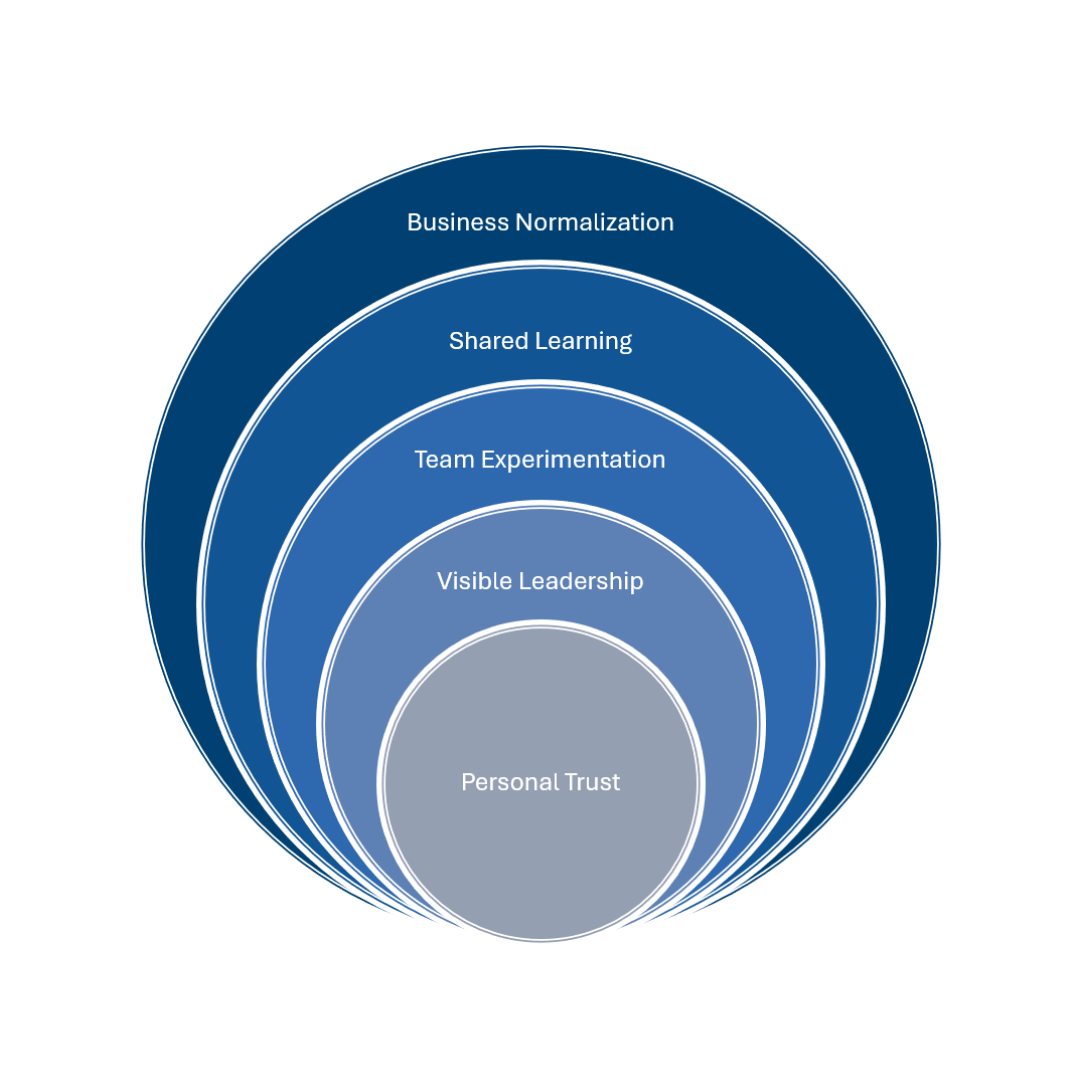 The organizations capturing value behave accordingly. McKinsey's high performers, about 6 percent of respondents, were nearly three times as likely as others to have fundamentally redesigned their workflows. They were also three times as likely to strongly agree that their senior leaders demonstrate ownership of and commitment to AI.
WHERE THE SYSTEMS COLLIDE
A systems view is proven by interaction, not inventory. Three collisions explain most of the stall.
Reward meets Authority. The organization rewards volume, and nobody has declared what AI is allowed to decide. Output rises. Judgment doesn't. AI output reads with the same confidence whether it's right or wrong, so review quietly thins out under volume pressure. That's how Judgment Debt builds: the compounding cost of decisions deferred to AI without encoding human reasoning into the process. The fix is to declare, workflow by workflow, how much autonomy AI has, and to reward work that moves forward rather than work that merely looks complete.
Reward meets Trust. When AI creates capacity and nobody says where it goes, people answer the question themselves, and they answer it from the reward system. Hours saved become more work, not more room. The early evidence points the same way. A study of Danish workers in AI-exposed occupations ruled out any effect on earnings or hours larger than 2 percent two years after ChatGPT's launch (Humlum and Vestergaard, NBER, 2025). People notice where the gains go. They aren't afraid of AI. They're reading the terms.
Knowledge meets Reward. AI's promise is that one expert's judgment can reach everyone. Look at that from the expert's chair. If you're paid and promoted for what you know, handing it to a system that gives it to a new hire works against you. So the best knowledge stays where it is, in people's heads.
Knowledge won't move against the grain of the reward system.
WHERE THE SYSTEMS LAND
All four systems converge on one role: the middle manager.
- Judged on KPIs written before AI.
- Accountable when an AI-assisted decision goes wrong.
- Owner of the team's workflows.
- The person whose behavior tells the team whether open use is safe.
The Wharton data shows the gap. Fifty-six percent of VP-and-above leaders believe their organization is adopting AI much faster than others. Among managers, it's 28 percent. Managers also report investing more in employee training, and giving employees more room to innovate, than senior leaders do.
Read that as signal, not resistance. Managers sit closest to the systems that haven't changed. They see the problem. They don't own the levers.
THIS IS NOT A TECHNOLOGY PROBLEM. IT IS A LEADERSHIP PROBLEM.
Every one of these systems sits on an executive's desk. The Chief AI Officer can't rewrite the comp plan. The CIO can't redraw decision rights inside a business line. Operations won't redesign a process nobody asked it to redesign. And no one can model the behavior for you.
AI never removes responsibility. It concentrates it. Here, it concentrates on the people who designed the systems in the first place.
THE OWNERSHIP CHECK
This week, pull up your AI plan. Write four lines: Authority, Reward, Knowledge, Trust. Next to each, write the name of the person accountable for changing it, and what has changed since the plan was approved.
Most executive teams will find tools, training, and policy on the page, and four blank lines.
Those blank lines are the invisible systems. They were never invisible. They were just never on the plan.
Start filling them this quarter. One first move for each:
- Authority: For your three highest-volume AI workflows, declare what the AI may decide on its own and what requires a human to sign.
- Reward: Replace one volume metric with an outcome metric, and say out loud where freed capacity goes.
- Knowledge: Make contributing expertise to the organization's AI part of how your senior people are evaluated.
- Trust: Use AI visibly in your own work this month, including where it got something wrong.
The value you're waiting for is sitting in systems you already own.
ABOUT THE AUTHOR
Scott Wise brings 30 years of transformation consulting experience to the most important leadership challenge of our time. Author of AI4Leaders: Amplify Your Impact and certified in AI by MIT and Oxford, he helps executive teams and organizations move from AI-Curious to AI-Capable. Explore his work at ScottWise.ai.