The Capacity for More: Automation Is Not Innovation
Jun 22, 2026
Every chart about AI and work tells the same story. A radar graph, a heat map, a bar chart — doesn't matter. The shape is always the same: a wide ring showing how much of your job AI can already do, creeping toward the edge. Knowledge work. White-collar work. The work you spent a career getting good at.
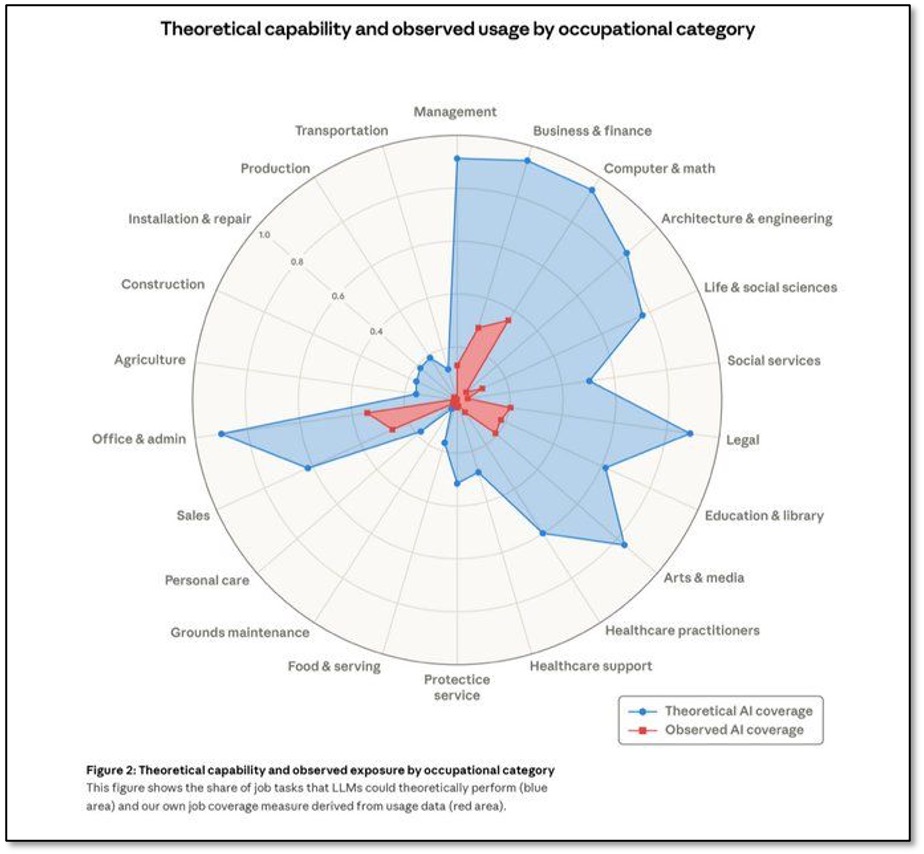
I've shown that chart from a stage several times this year. I watch the room read it the same way every time. Arms cross. Shoulders set. People do the math on their own job in real time, and the math feels like a countdown.
That reaction is reasonable. It's also half the picture.
The goal was never to do the same thing, faster. AI compresses the time, capital, and talent required to build new capabilities — and that compression, not acceleration of what you already do, is what creates capacity for more. But more only compounds into something valuable when it's aimed at what's uniquely yours — your domain, your purpose, your meaning. Aimed well, that capacity becomes either greater depth in who you already are, or the power to become a new expression of it. Aimless, it's just a faster way to drift. Automation is not innovation.
Let me show you what I mean.
The Shortcut Nobody Built For
A numbers person doesn't get faster at math. They get a shortcut into the creative capability they never had time to build. A creative doesn't get faster at being creative. They get a shortcut into the strategic capability that used to take a decade to learn or a consultant to pay.
That's not a metaphor. It's closer to a measurable mechanism than most people realize. Researchers at Harvard, MIT, and the Boston Consulting Group ran a field experiment with 758 management consultants on real, knowledge-intensive work. Consultants using AI didn't just go faster — they completed more of the work, finished it in a quarter less time, and produced output rated 40% higher in quality. The biggest gains showed up in the people who started furthest behind. A separate study tracking thousands of customer support agents found something similar: workers with AI access and two months on the job performed like veterans with six months of experience and no AI. The apprenticeship didn't get easier. It got shorter.
I call this capability arbitrage. Not because it's a clever phrase, but because it's the most accurate description of what's actually happening. You're not working harder inside your lane. You're buying your way into a lane you never had time to build — at a fraction of the traditional cost in years, tuition, or trial and error.
Here's the part most of the AI conversation skips: that arbitrage only pays off when it's aimed at something. Point it at your own purpose, your own domain, the thing you were already building toward, and it compounds. Point it at nothing in particular, and you've just found a faster way to produce more noise, more confidently, at greater volume. The same research that proves the upside also found the trap door — when those same high-performing consultants were pushed onto work explicitly outside the AI's depth, the ones using AI did worse than the ones without it. Confidently. The tool didn't know the difference between a real answer and a polished one, and neither did they, because the judgment to tell the difference is exactly the thing a shortcut can't supply. Capacity without an aim isn't innovation. It's just drift with better production values.
I've watched this play out close enough to recognize the pattern. Four versions of it, actually — all different people, all the same underlying move.
Four People, One Move
A marketing leader I know spent years running campaigns for other people's businesses. He didn't get faster at marketing. He used AI to teach himself something adjacent he'd never had bandwidth to learn — building a real operating model for how an agency runs, not just what it produces. He's not pitching more clients. He's running a business that finally matches the instincts he already had. More revenue, yes. But also more quality control, and — the part he mentions first — more actual time with his family, because the model runs without him standing over it.
A management consultant I know well made a similar pivot. He didn't become a faster consultant. He used AI as a thinking partner — not an assistant, a partner — and stepped into work as a writer and speaker helping other people navigate the same AI upheaval he was living through. He didn't get more efficient at his old job. He built a new one out of the parts of his thinking that AI couldn't replace. More differentiated thinking. More value per conversation. More of what he'd actually call himself, if you asked.
A professor I've worked with took the harder route. Most of his peers were busy writing AI-detection policy. He used the same tools to do the opposite — he became the person on campus who could move faculty and students from "AI is cheating" to "AI is a catalyst," one uncomfortable conversation at a time. He didn't get faster at lecturing. He built a capability that didn't exist in his job description: institutional mindset change. More critical thinking in his classroom. More curiosity from students who'd stopped expecting to feel any. More graduates that hiring managers actually want.
And then there's the executive — new company, new market, a culture that didn't trust her yet and had no reason to. She didn't use AI to write faster memos. She used it as a boardroom challenger, a tool to pressure-test her own thinking before she ever brought it into a room full of people deciding whether to believe her. She didn't get more output. She got an anchor of discernment for decision cycles that had gotten too fast for anyone to think clearly inside them. More board trust. More team conviction. The kind of credibility that doesn't show up on a dashboard but is the entire reason the dashboard gets believed.
Notice what none of them reached for. Not more output. Not more speed. Not more volume. When capacity is aimed by purpose, what we reach for is an amplification of our existing expertise — not more throughput.
Look at the pattern again, side by side. None of them used AI to do their existing job faster. All four used it to build a capability they didn't have, in a direction their own purpose was already pointing — and the thing they gained back wasn't efficiency, it was depth. More quality time, not more hours billed. More differentiated thinking, not more content. More critical thinking in a classroom, not more lectures delivered. More board trust, not more decisions made per quarter. Same mechanism, four different lives, one identical move: aim the capacity at what's already yours, and what comes back is more of who you are — not more of what you produce.
What the Chart Actually Shows
Go back to that radar chart for a second — the one with the wide blue ring of theoretical AI coverage stretched out across white-collar work. Anthropic's own research shows the gap between what AI can theoretically do and what's actually being deployed inside real organizations is enormous. Most of that capability is sitting unused. Not because it doesn't work. Because deployment is a people problem, not a model problem, and people problems move slower than benchmarks.
I used to show that chart as a warning. The gap as a countdown clock — close it before it closes on you. That's still true, and it's still worth taking seriously. But it's an incomplete read. The same gap that looks like exposure from one angle looks like unclaimed capacity from the other. The size of that blue ring isn't just a measure of what could replace you. It's a rough measure of how much capability compression is sitting on the table, waiting for someone to aim it at something that matters.
The four people I just described didn't close that gap by working inside their job descriptions faster. They closed it by reaching past the edge of what they were trained to do, in a direction their own purpose was already pointing.
That's the distinction the chart can't draw for you, because a chart can only measure capability — it has no way to measure aim. Two people can stand in front of the exact same blue ring, looking at the exact same percentage of their occupation theoretically covered, and walk away with completely different outcomes. One spends that capacity drifting sideways into faster versions of work nobody asked for. The other spends it the way the marketing leader, the consultant, the professor, and the executive did — pointed at something they already knew was theirs to build. The chart is identical. The result isn't close.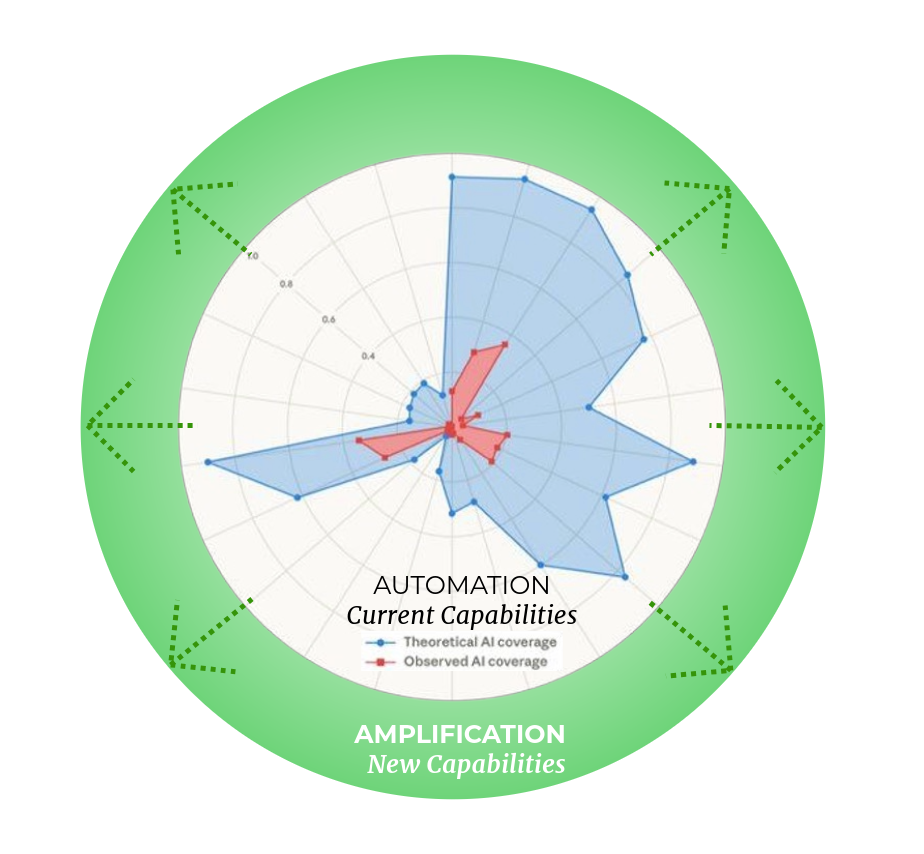
The Question That Actually Matters
The real risk was never that AI takes your job. The real risk is that you get more capacity and spend it on the wrong thing — louder content, faster mediocrity, a bigger version of work that didn't need to exist in the first place. Capability without an aim isn't an advantage. It's just exposure with extra steps.
So here's the only question worth sitting with, because every other question about AI is downstream of it:
Capacity for more — what?
Not more output. Not more speed. Name the thing. The depth you've been meaning to build, or the new expression of your work you've been circling for years without quite landing on. AI didn't create that ambition. It just removed most of the excuses for not pursuing it.
If you want to think through what that looks like for you and the people you lead, that's exactly the conversation we have inside AI4Leaders at ScottWise.ai. The concept is the easy part to show you. The conviction is the part worth building together.
Scott Wise brings 30 years of transformation consulting experience to the most important leadership challenge of our time. Author of AI4Leaders: Amplify Your Impact and certified in AI by MIT and Oxford, he helps executive teams and organizations move from AI-Curious to AI-Capable. Explore his work at ScottWise.aisuing it.