The Vanishing First Rung: How AI Is Rewriting the Start of the Career Ladder
Feb 11, 2026
Entry-level jobs are quietly disappearing—or being reshaped beyond recognition. For decades, early-career roles served as proving grounds where new professionals developed skills, judgment, and organizational fluency. But in the age of AI, many of those baseline responsibilities are being automated or reallocated to experienced staff augmented by intelligent tools. The impact is a subtle but profound shift in how the workforce develops, and who gets the chance to develop at all.
The Disappearing On-Ramp
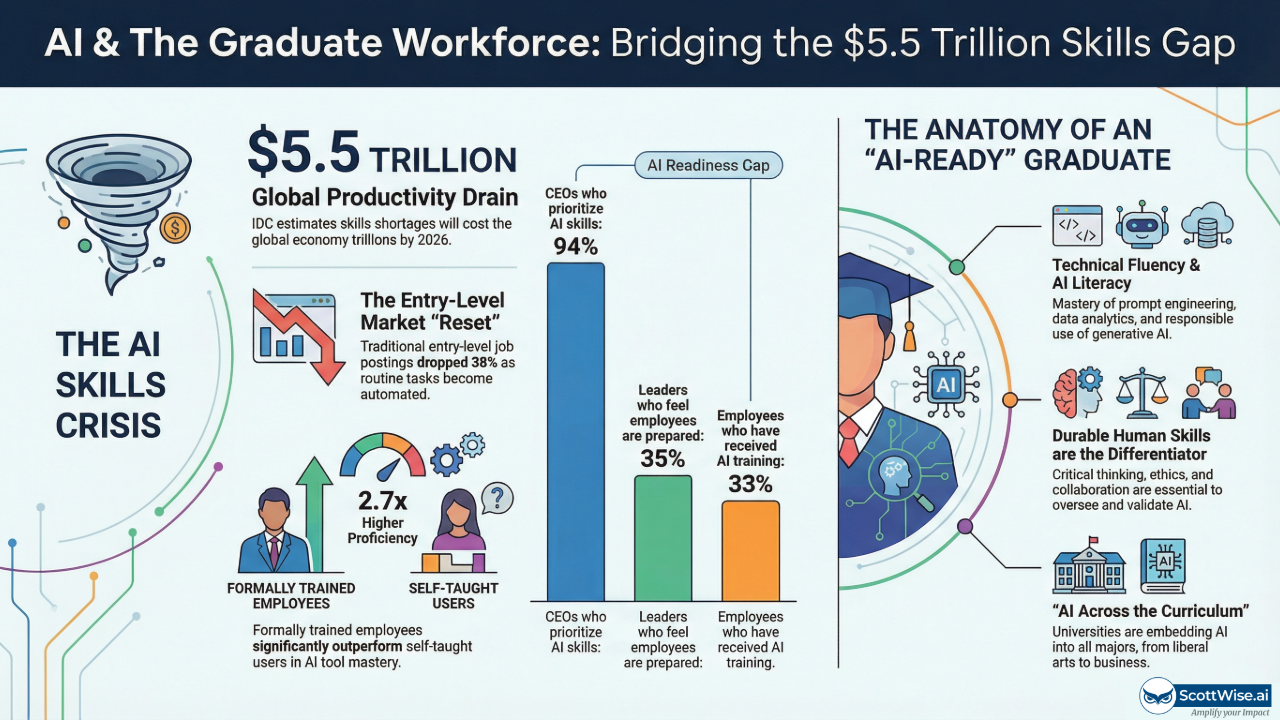
In 2023, entry-level job postings in the U.S. dropped by as much as 38% across several sectors, according to Lightcast and labor market analysts. This decline has been especially sharp in positions exposed to automation, such as marketing coordinators, junior analysts, customer support roles, and administrative assistants. Meanwhile, new AI-enabled tools are handling everything from data summarization and customer service queries to first drafts of reports and presentations.
Companies are no longer hiring entry-level professionals just to "pay their dues" and build up to higher-value contributions. With AI systems able to perform a large portion of the repetitive or lower-skill tasks that traditionally filled early-career roles, organizations are flattening their structures, hiring fewer juniors, and investing in more experienced talent who can leverage AI directly.
According to a 2025 report by IDC, the global economy risks losing $5.5 trillion in potential productivity over the next few years due to a persistent skills gap in AI and related technologies. And yet, even as CEOs rank AI adoption as a strategic priority (“94% of CEOs say AI is critical to their business model”), only 35% believe their workforce is adequately prepared to use it effectively. This disconnect has created what some analysts are calling a "capability vacuum" at the start of the career pipeline.
What We Lose When Entry-Level Work Disappears
The entry-level job has historically served a dual purpose. For employers, it provided inexpensive labor and a talent pool to evaluate and shape. For young professionals, it was a laboratory for learning—a place to develop soft skills, navigate ambiguity, understand workplace dynamics, and make early mistakes in a relatively forgiving context.
When those roles vanish or become unrecognizable, both sides lose. New grads enter the workforce with limited practical exposure. Teams inherit professionals with academic credentials but little applied judgment. And organizations find themselves with a growing gap between what needs to be done and who is prepared to do it.
The longer-term consequence is more troubling: the ladder to leadership starts to splinter. As entry-level jobs evaporate or require significantly more baseline capability (including AI fluency), a wider group of people may be shut out of the first rung entirely. This disproportionately affects underrepresented and first-generation professionals who rely on early career jobs to build upward mobility.
The Redefinition of Entry-Level Work
While it may feel like these roles are disappearing, in many cases they are being redefined. Entry-level jobs are not vanishing so much as evolving—from task execution to augmented contribution. Consider these emerging realities:
-
AI is now a co-worker. Many entry-level roles assume that the new hire will know how to collaborate with tools like ChatGPT, Microsoft Copilot, or sector-specific AI assistants. Prompt engineering, workflow automation, and critical evaluation of AI outputs are quietly becoming baseline expectations.
-
Soft skills matter more. As AI handles more of the technical lift, the premium shifts to durable human capabilities: judgment, communication, initiative, and collaboration. The capacity to lead, even without authority, is a key differentiator.
-
Work starts at a higher bar. Companies expect new hires to deliver value more quickly, often within the first few weeks. There's less tolerance for a slow ramp-up or "learning on the job" without scaffolding.
-
Hybrid and remote dynamics change exposure. In-person mentorship, osmosis learning, and informal feedback loops have diminished. In their place, AI-supported knowledge systems and structured feedback are rising—but they are no substitute for contextual, human learning.
In short, new grads are being hired to work with AI, not just alongside it. And the ones who succeed are those who come in already equipped to adapt.
Higher Education's Mandate: From Gatekeeper to Launchpad
This shift places new pressure on universities. Traditional curricula that focus narrowly on subject matter expertise and theoretical foundations risk graduating students who are technically credentialed but practically unprepared.
The American University Kogod School of Business recently revamped its entire curriculum in under six months to embed AI literacy and tooling into every major. The result? A 25% projected increase in next year’s incoming class, signaling strong student and market demand.
Similarly, institutions like the University of Florida and Ohio State University have launched AI-across-the-curriculum initiatives, ensuring students in all majors receive AI exposure, regardless of discipline.
These examples represent the leading edge of a broader transition. To rebuild the early-career ladder, higher education must:
-
Embed AI fluency across disciplines
-
Prioritize experiential learning tied to real-world tools
-
Integrate ethical reasoning and human judgment into technical instruction
-
Equip faculty with the capabilities to teach and model AI integration
Doing so doesn’t mean turning every student into a data scientist. It means ensuring every graduate knows how to think critically with AI, not just about it.
Rethinking Corporate Talent Strategy
For employers, the message is equally clear: reimagining early-career development is not just a learning challenge—it’s a leadership imperative.
Companies must ask:
-
If AI has displaced the learning curve, where are we intentionally placing new ones?
-
Are we hiring for skills or for potential? And are we investing in that potential post-hire?
-
How are we measuring early-career growth now that traditional roles and ladders no longer apply?
Progressive firms are already experimenting. Zurich Insurance and Wake Tech Community College created a shared apprenticeship model where students earn wages while developing applied AI skills. Other organizations are integrating generative AI training into onboarding or pairing new hires with AI mentors to accelerate capability development.
Some are even beginning to assess AI readiness as part of the interview process—not just technical skill, but the mindset and adaptability required to work alongside automation.
Rebuilding the Rungs: A Shared Responsibility
If we fail to create new onramps into the workforce, we risk not only a talent shortage but a societal one. The ability to contribute meaningfully to the economy—to move from potential to performance—has long depended on fair access to early-career opportunities.
Rebuilding those rungs requires more than lamenting what AI disrupts. It means designing new learning ecosystems, bridging academia and industry, and treating capability-building as a shared responsibility.
Universities must adapt curriculum design to reflect modern workflows. Employers must be willing to invest in scaffolding early-career growth. And both must recognize that in an AI-augmented economy, the most valuable human advantage we can build is not control over technology, but confidence within it.
The ladder isn’t broken. But the entry point needs reinforcement.
Let’s build it—before the next generation tries to climb and finds nothing to grab onto.