AI Fails Without a Human Focused Strategy
Feb 24, 2026
AI Adoption Is a Leadership Imperative — Not an IT Initiative
There is a dangerous narrative currently spreading through boardrooms and executive teams. It sounds sophisticated and is backed by historic corporate investment, but it is fundamentally flawed. The narrative assumes that artificial intelligence is a technology transformation. It is not; AI is a human transition.
Across industries, executives are anticipating trillions in projected economic value, yet inside their own organizations, they face a frustrating reality: pilots that never scale, tools disconnected from workflows, and minimal measurable ROI. This is the "AI Adoption Gap". It is not caused by insufficient technology; it is caused by insufficient leadership alignment. Research indicates that the majority of implementation challenges stem from culture and change management—the technology is ready, but organizations are not. If AI represents an economic reset, hesitation is not neutral; it is erosion.
The AI4Leaders Maturity Curve: Where Do You Stand?
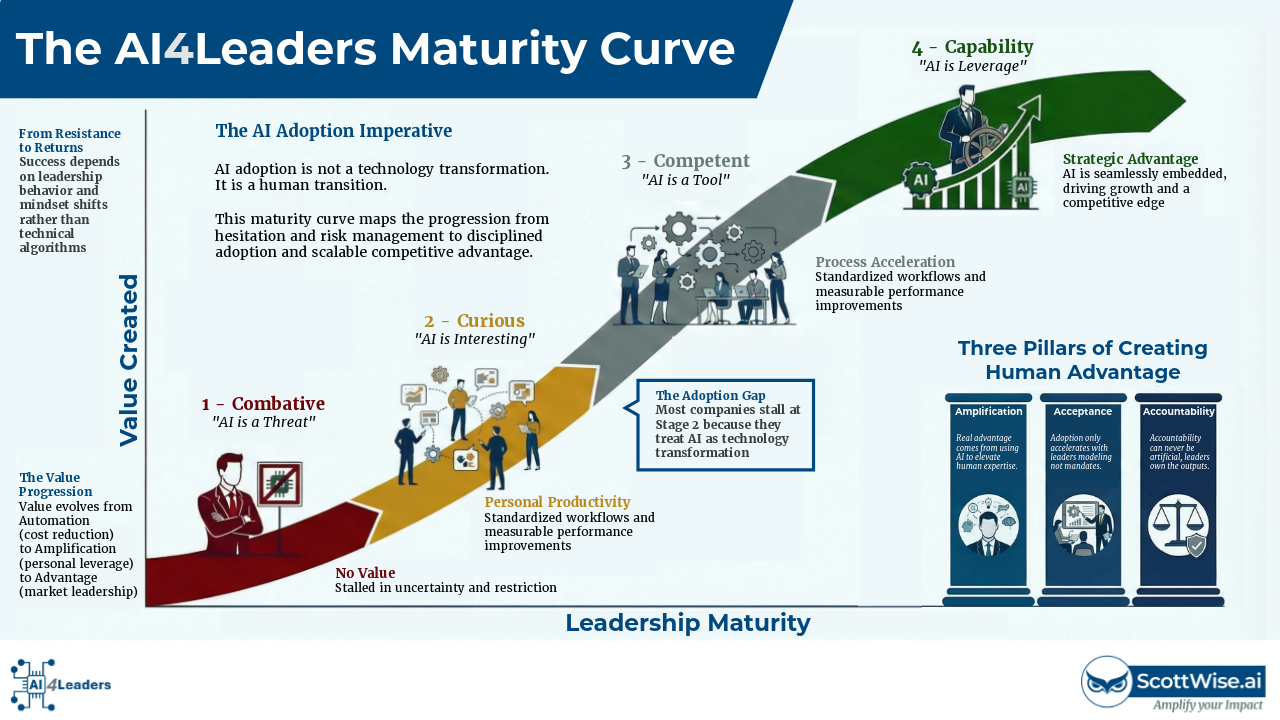
To understand the urgency of this transition, leaders must reframe AI adoption from an IT rollout to a leadership maturity journey. The progression of an organization can be mapped on a maturity curve where the vertical axis represents AI Value Creation and the horizontal axis represents AI Leadership Maturity. Organizations typically fall into one of four stages:
- Combative ("AI is a threat"): Leaders resist AI due to fears regarding risk, IP, and loss of control. Policies are prioritized over possibilities, resulting in near-zero value creation.
- Curious ("AI is interesting"): Experimentation begins, but it is fragmented. Leaders use AI for personal productivity, like emails or summaries, but the technology remains an assistant rather than a true capability. This is where most leaders currently sit.
- Competent ("AI is a tool"): AI is integrated into specific workflow steps, yielding measurable performance improvements and process acceleration. However, this capability remains siloed at the individual level, limiting institutional scale.
- Capability ("AI is leverage"): This is the ultimate inflection point. AI is seamlessly embedded into the operating model, and domain expertise is encoded into scalable, repeatable decision systems. AI provides a compounding structural advantage.
Why Most Organizations Stall in the Middle
Most companies oscillate indefinitely between the Curious and Competent stages. They stall because they treat AI like software rather than a behavioral shift. They deploy tools without shared norms, modeled leadership use, or clear accountability standards, mistaking universal access to AI for a competitive advantage. Advantage does not come from access; it comes from integration, which is a strictly human discipline.
The Three Pillars of Human Advantage
To move beyond basic access and build a true competitive edge, leaders must master three foundational pillars.
- Amplification: Amplify strategic leverage to accelerate decision velocity. AI's highest value is not cost-reducing automation. While most use AI to automate the 80% of tasks yielding low impact, true advantage comes from amplifying the 20% of high-impact leadership activities—such as strategic thinking, scenario modeling, and risk evaluation. When AI enters the reasoning process, decision velocity increases.
- Acceptance: Accelerate organizational adoption through visible leadership modeling. Adoption does not grow through top-down mandates; it grows through modeling. Employee resistance to AI is emotional, driven by fears of looking replaceable or making public mistakes. When executives visibly, responsibly, and transparently use AI in their own analysis and communications, they remove the stigma. Culture shifts when curiosity is seen, not simply declared.
- Accountability: Retain ethical judgment to scale institutional trust. AI can generate massive volumes of insights, but it cannot own the consequences. Volume without human validation creates a dangerous illusion of certainty. Leaders must remain firmly responsible for accuracy, alignment, and ethical judgment. Accountability is not a brake on innovation; it is the trust engine that allows it to scale securely.
From Curiosity to Capability: Architecting the Transition
The shift from fragmented curiosity to institutional capability does not happen organically. It requires intentional design and structured corporate adoption programs. To truly change the curve, organizations must implement a structured path focused on execution:
- A Leadership Reset: Move AI from an IT initiative to a core leadership responsibility, confronting real tensions like governance uncertainty and cultural resistance.
- Structured Capability Building: Behavior change takes time. Programs must unfold over weeks, allowing leaders to practice visibly and normalize experimentation. Consistency compounds capability.
- Artifact Creation: Curiosity creates dialogue, but capability requires documentation. Leaders must encode their voice, judgment standards, and decision playbooks into tangible AI knowledge assets. By grounding AI in institutional artifacts, outputs stop being generic, and leaders stop endlessly re-explaining how they think.
- Visible Leadership Modeling: Leaders must demonstrate AI use in real workflows, such as preparing briefs or analyzing trade-offs, making experimentation safe for the broader team.
- Trust-Building Governance: Instead of reacting with restrictions, establish proactive accountability standards, validation expectations, and risk thresholds that protect trust while accelerating adoption.
- Economic Alignment: Explicitly connect AI capabilities to economic levers like pricing optimization and decision velocity. Innovation pipelines must be disciplined and measurable.
- Cohort-Based Momentum: Progression is contagious when leadership teams learn together, share wins, and build peer accountability.
The Economic Stakes and Your Next Step
The AI era is not about reducing headcount; it is about redefining leadership contribution. As AI absorbs lower-value transactional tasks, workforce leverage moves upward. The premium shifts to leaders who can frame better questions, evaluate trade-offs faster, and navigate ambiguity with confidence.
If you are an executive, your decision is not whether AI matters, but whether you will lead the transition or manage the consequences of failing to do so. Every month your organization hesitates, competitors are refining workflows and compounding their strategic leverage. The technology transformation is fully visible, but the human transition is decisive. Leadership behavior determines which side of the curve you end up on.