Beyond the Binary: The 3rd Rail in the AI Futurist Debate
Mar 04, 2026
Why the "Productivity Boom" vs. "Intelligence Crisis" debate misses the rise of the Entrepreneur Economy.
The Viral Debate: AI Economic Boom or Bust
As artificial intelligence accelerates into the mainstream of business, a polarized debate has captured the attention of strategists, economists, and executives. When we attempt to forecast the macroeconomic fallout of AI, most conversations default to one of two futures: a utopian dream or a dystopian nightmare.
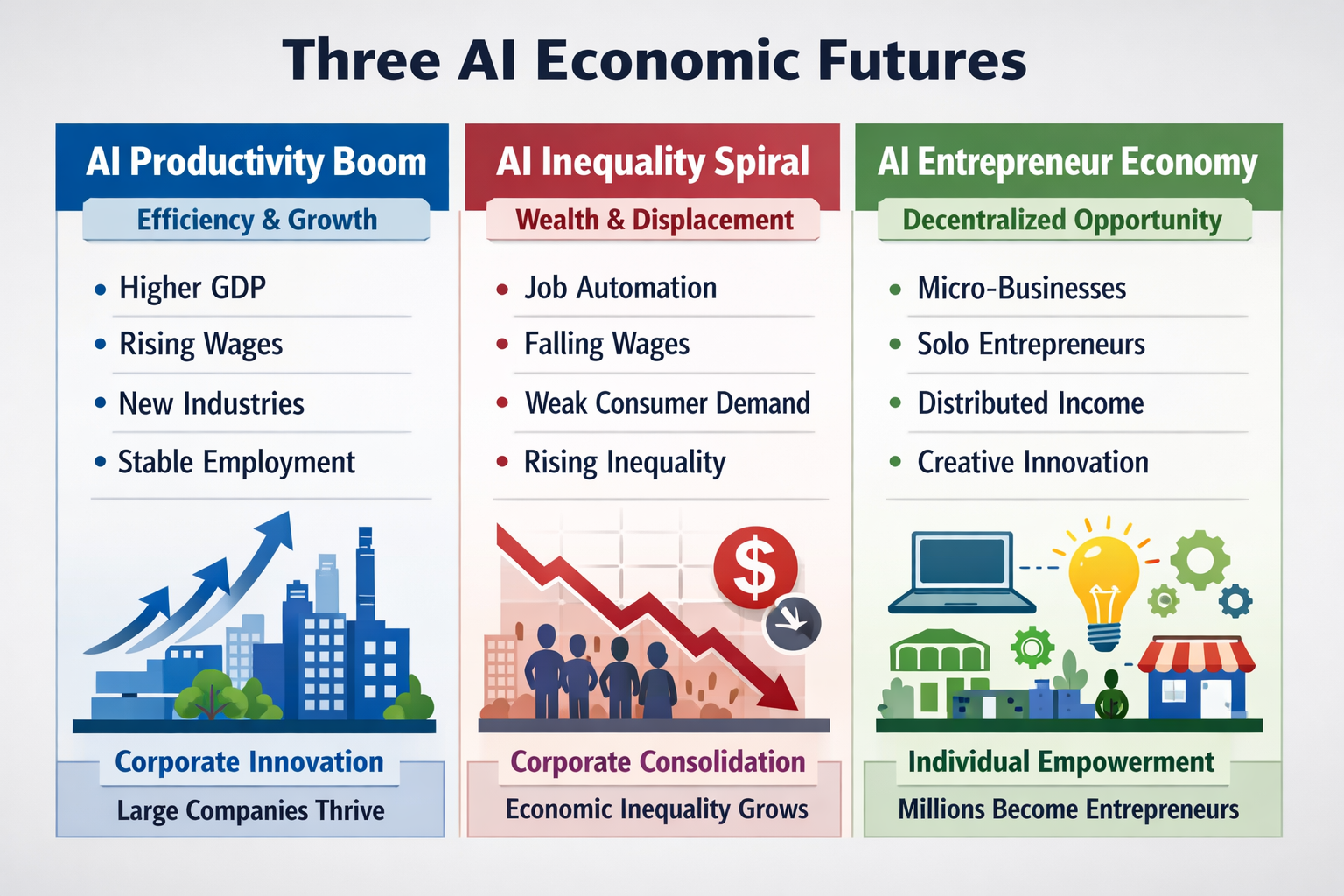
The first view is the Productivity Boom, an optimistic scenario where AI unleashes a wave of efficiency similar to past technological revolutions. In this model, we see corporate innovation driving higher GDP, rising wages, new industries, and stable employment.
The second view is the Inequality Spiral. Cautionary analysts argue that AI will rapidly replace cognitive labor, particularly in knowledge-based industries. In this model, white-collar displacement triggers a negative feedback loop: corporate profits skyrocket as labor costs vanish, but falling wages weaken consumer demand, and systemic economic inequality takes root.
Both of these scenarios are intensely debated and entirely plausible. Yet, they share a profound, hidden assumption that deserves immediate scrutiny from today's business leaders.
The Flaw in the Binary Debate: The Industrial Age Hangover
The fatal flaw in both the Productivity Boom and the Inequality Spiral is that they assume the primary engine of economic value creation will remain exactly the same as it has been for the past century: the large organization coordinating human labor.
To understand the weight of this assumption, we must reflect on the economic architecture we inherited from the industrial era. For over a hundred years, the large corporation has been the dominant model of economic organization because industrial production required immense scale. Factories, global supply chains, and capital-intensive infrastructure demanded centralized coordination, and large organizations aggregated the capital and human workforces required to produce goods efficiently.
As a result, economic participation became inextricably linked to corporate employment. Workers exchanged their time and expertise for wages, while corporations provided the platform for productivity. This created a structural dependency—what we might even call a form of corporate socialism. Massive corporations provide stability and a paycheck in exchange for control, demanding long hours and dictating predefined paths for success. We have tied income, benefits, retirement security, and professional identity directly to one's position inside a corporate hierarchy.
Both sides of the current AI debate assume this dependency will persist. They simply argue over whether AI will make these massive corporations hire more people (the boom) or fire more people (the spiral).
What receives far less attention is a third possibility—one that challenges the very structure of the industrial firm and promises significantly broader positive impacts for society.
The Paradigm Shift: From Automation to Amplification
To understand this third path, we must rethink our fundamental definition of artificial intelligence in the workplace. The current corporate narrative is heavily skewed toward automation—the idea of using machines to replace human effort and reduce headcount. But for leaders looking to truly multiply their effectiveness, the real power of AI lies in amplification.
Artificial intelligence fundamentally changes the economics of capability. Historically, competing in the marketplace required assembling large teams of specialists: analysts for research, marketers for campaigns, engineers for product development, and managers to coordinate the friction between them all. Human limitations meant that building anything complex required significant capital, large headcounts, and time.
AI alters that equation. However, this does not mean humans disappear from the equation. Rather, the relationship between human creativity and technological capability changes. When we embrace true "co-intelligence," AI becomes a partner used to amplify our unique human strengths and create value in entirely new ways. It is about using AI as a cognitive exoskeleton that expands our individual agency and distributes the capacity to create value more broadly across society.
In economic terms, the cost of capability is collapsing. Capabilities that once required dozens of people can now be orchestrated by small teams or even single individuals supported by AI tools. When the cost of executing complex ideas falls far enough, the barrier to launching and operating a business declines dramatically, and entrepreneurship naturally expands.
The Third Path: The Entrepreneur Economy
This brings us to the third AI economic future: The Entrepreneur Economy.
This model emerges when individuals gain access to tools that allow them to create immense value independently, without requiring the bloated infrastructure of large organizations. AI becomes, in effect, the operating system of entrepreneurship.
Consider the practical implications of decentralized opportunity:
- A solitary consultant, equipped with AI analytical tools, can operate like a boutique strategy firm, delivering insights that once required an army of junior analysts.
- A single developer can build software services with agentic coding tools, reducing development timelines from months to mere days.
- A finance professional can design highly specialized analytics platforms for niche markets without needing a multi-million-dollar engineering budget.
In the Entrepreneur Economy, millions of people transition from being passive employees within a large corporate machine to capable, independent economic actors. The distance between having an idea and launching a functioning, profitable enterprise shrinks to almost nothing.
Moving Toward an "Economy of Purpose"
This transition represents the end of the traditional time-for-money exchange. In the corporate structure, your value is intrinsically tied to the hours you sit at a desk. In the Entrepreneur Economy—driven by human amplification—your value is defined strictly by the impact you create and the outcomes you deliver.
Because AI handles the heavy lifting of processing and execution, time is reclaimed. Time, rather than just capital, becomes the ultimate currency. This enables an "Economy of Purpose," where financial security no longer requires sacrificing mental health, family time, or personal growth to corporate hierarchies. Next-generation entrepreneurs are not building businesses just to replicate the corporate grind; they are building micro-businesses that align with their personal values, leveraging AI to amplify their capabilities while they focus on creating solutions that actually matter to them.
The Broader Positive Impacts: Resilience, Innovation, and Agency
For executives and macroeconomic policymakers, cultivating the Entrepreneur Economy offers profound systemic benefits that neither the Productivity Boom nor the Inequality Spiral can provide:
1. Unprecedented Economic Resilience Large corporations concentrate economic risk. When a major employer in a traditional economy restructures or implements AI-driven downsizing, entire communities experience simultaneous, devastating income shocks. The Entrepreneur Economy distributes this risk. By spreading economic activity across a massive, decentralized base of micro-businesses and solo entrepreneurs, we reduce systemic concentration risk.
2. Accelerated, Distributed Innovation Bureaucracy is the enemy of disruption. Many of the most transformative ideas historically emerged from individuals or small teams operating outside the constraints of large institutions. Lower barriers to entrepreneurship mean a massive, exponential increase in the number of experiments taking place across the economy simultaneously. Millions of minds, amplified by AI, will tackle niche problems, resulting in a vastly more dynamic and adaptive economic system.
3. Restored Human Agency and Societal Wellbeing Modern corporate structures have produced extraordinary economic achievements, but they have alienated the workforce. Countless professionals today report a deep sense of disconnection between their daily work and their personal sense of purpose, feeling constrained by organizational silos that stifle autonomy. The Entrepreneur Economy enables a fundamental shift in how people experience professional life. When individuals have the tools to design their own economic activities, they align their work directly with their curiosities, strengths, and community needs. The result is not just economic growth, but fewer broken families, healthier individuals, and a society that values meaningful contribution over mere attendance.
The Executive Mandate: Choosing Amplification Over Inertia
As leaders, we must recognize that the Entrepreneur Economy is a choice, not an inevitability.
Economic structures often persist long after the technologies that shaped them have changed. There is a very real risk of structural inertia. If access to high-level AI capabilities becomes walled off, concentrated within a small number of massive technology platforms, or used by corporate environments strictly as an automation tool to cut costs, the economic benefits will remain centralized. In that scenario, we default to the Inequality Spiral: corporations capture most productivity gains, employment opportunities contract, wealth concentration increases, and economic participation narrows.
The difference between these futures depends less on the underlying technology itself, and more on how we choose to distribute AI capabilities across society. Technological revolutions only create new possibilities; societies must shape how those possibilities are realized.
If we want the broader positive impacts of the Entrepreneur Economy, we must actively design for it. This means executives, investors, and policymakers must champion open access to AI tools, invest heavily in entrepreneurial education, and advocate for regulatory frameworks that protect the individual creator.
We are approaching one of the most significant economic transitions since the Industrial Revolution. If we get this right, artificial intelligence will not replace human potential; it will expand it. It will lead to a world where more people are active creators of solutions rather than mere employees within large systems.
Let us build the infrastructure for an economy of purpose, where AI is not used to automate us out of the picture, but to amplify our greatest human impacts.