Historically, Technology Elevated Human Work. That Streak Just Ended.
Apr 20, 2026
Why this technology wave demands a fundamentally different response from every leader in every industry.
Someone asked me a question at a lunch and learn recently that stopped me mid-thought.
"Why is AI any different than previous technology advancements?"
It was a fair question. A smart question, actually. And most people in most rooms are answering it wrong.
They compare it to the internet. To the cloud. To the ERP rollout that consumed three years and two CFOs. They conclude that AI is another wave to manage — another tool to adopt, another change initiative to survive — and they return to their existing approach.
That framing is costing them.
Here is the argument I made — and the data that supports it.
The Pattern We've Always Relied On
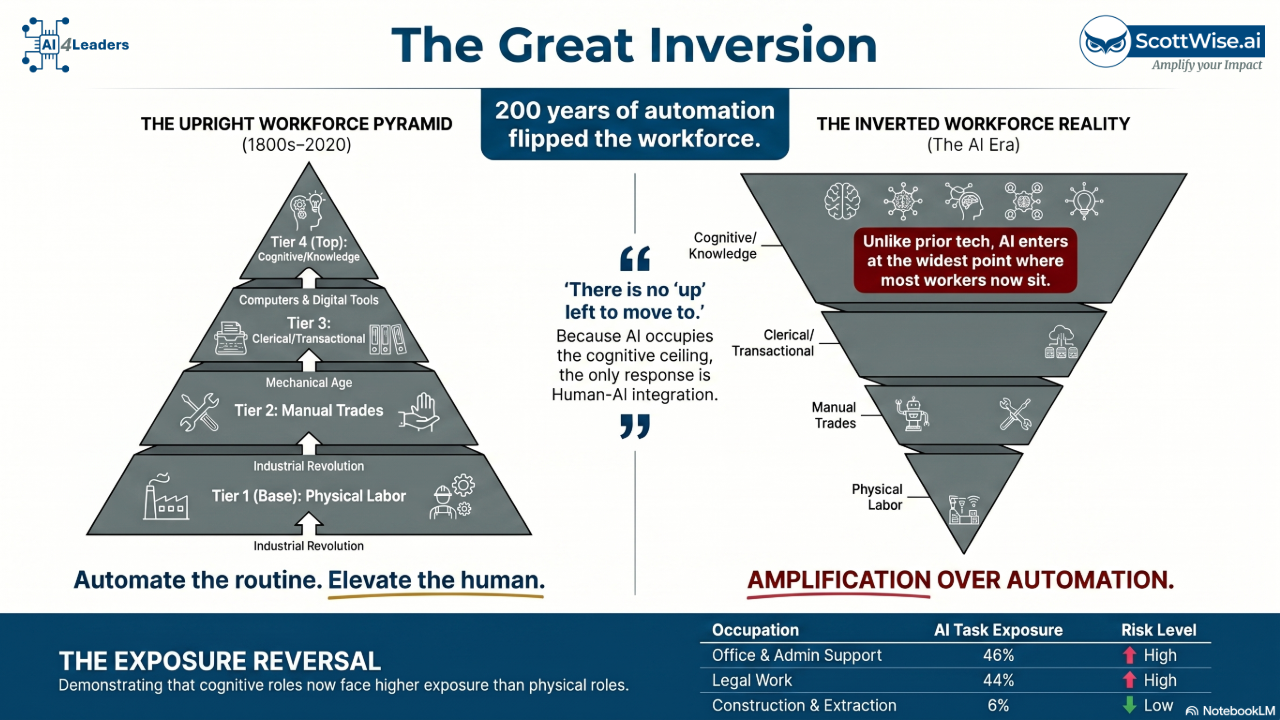
For two centuries, every major wave of technology followed the same playbook. Automation targeted physical labor first.
The Industrial Revolution mechanized muscle. Steam and machinery displaced farm workers and manual trades, and workers moved into factories. Then computers came for clerical and transactional work — bookkeepers, data entry operators, switchboard operators — and workers moved into knowledge roles. Analysis. Strategy. Judgment. Creative problem-solving.
Each wave created disruption and each wave had a resolution. The resolution was always the same: move up. Automate the physical, elevate to the cognitive. Automate the transactional, elevate to the strategic.
Knowledge work — the domain of lawyers, analysts, consultants, financial advisors, engineers, executives — was the safe harbor. Every prior wave of automation confirmed this. The higher you climbed into judgment and expertise, the more secure your position.
For two hundred years, the pattern held. Automate the routine. Elevate the human.
That pattern is no longer holding.
The Inversion No One Saw Coming
In March 2023, Goldman Sachs published research that quietly rewrote the rules. Their economists analyzed AI's exposure across every major profession. The results inverted everything we thought we knew.
- Legal work: 44% of tasks exposed to AI automation — Goldman Sachs, March 2023
- Office & administrative support: 46% of tasks exposed — Goldman Sachs, March 2023
- Construction & extraction: 6% of tasks exposed — Goldman Sachs, March 2023
- Installation, maintenance & repair: 4% of tasks exposed — Goldman Sachs, March 2023
Read those numbers again. Construction workers: 4-6% exposure. Lawyers and knowledge professionals: 44-46% exposure.
Every prior automation wave moved from the physical up toward the cognitive. This one starts at the top.
A separate OpenAI research paper published the same year found that roughly 80% of the US workforce could have at least 10% of their tasks affected by large language models — and that higher-income, higher-education jobs face greater exposure than lower-income jobs. That is the exact inverse of every historical pattern.
McKinsey's research reinforced this: generative AI could automate activities that currently consume 60-70% of employees' time. Not routine tasks at the margins. Core cognitive work.
The safe harbor is now the target. The cognitive layer — analysis, judgment, expertise — is precisely where AI operates.
This is not a commentary on whether those jobs will disappear. That debate is ongoing and unsettled. This is a commentary on something more immediate: the response required of every leader is categorically different than anything prior technology demanded.
Why This Changes Everything for Leaders
Previous technology waves required leaders to manage change in their organizations. AI requires leaders to manage change in themselves.
BCG's research — drawn from studying hundreds of AI implementations across industries — established what has become a foundational principle: 10% of AI value comes from the algorithm, 20% from technology and data, and 70% from people and business process change. Not technology readiness. Human readiness.
That finding explains the current landscape. According to a RAND Corporation analysis, more than 80% of AI projects fail — twice the failure rate of comparable IT projects. A 2025 MIT study found that 95% of enterprise generative AI pilots deliver no measurable financial impact. BCG's own 2024 survey found 74% of companies struggle to achieve and scale value from AI.
These are not failures of technology. The models work. The tools work. The failures are organizational. They are leadership failures — failures to redesign workflows, to build human capability, to change the behavior of people who are uncertain about what their role now means.
- 74% of companies struggle to achieve and scale value from AI — BCG, 2024
- 95% of enterprise gen AI pilots deliver no measurable P&L impact — MIT Project NANDA, 2025
- 80% of AI project failures are organizational, not technical — RAND Corporation, 2024
These statistics describe a consistent pattern. The technology is ready. Organizations are not. And the gap between them is a leadership gap — not a technology gap.
The Speed Is Unlike Anything Before It
There is a second dimension that separates this moment from prior technology waves: the pace at which the gap between leaders and laggards is compounding.
The telephone took 50 years to reach 50 million users. Television took 22 years. The internet took 7 years. ChatGPT reached 100 million users in approximately two months.
That speed statistic is frequently cited. The more important statistic is what is happening inside organizations right now as a result of that speed.
BCG's September 2025 research — tracking more than 1,250 C-level executives across 25 sectors — found that only 5% of organizations qualify as "future-built" AI leaders. Those organizations are achieving 1.7x revenue growth and 3.6x total shareholder return compared to laggards. And they are outspending laggards on AI by more than two to one, compounding their advantage every quarter.
- AI leaders: 1.7x revenue growth, 3.6x shareholder return vs. laggards — BCG, September 2025
- Only 5% of firms qualify as 'future-built' AI leaders — BCG, September 2025
- AI adoption jumped from ~50% to 72% in a single year — McKinsey State of AI, 2024
In past technology waves, organizations that delayed could still catch up. The cycles were forgiving. A company that arrived late to cloud computing could close the gap within a few years.
This cycle is different. The combination of accelerating adoption curves and compounding organizational capability means that the gap is widening faster than most leaders realize. BCG's Nicolas de Bellefonds framed it directly: organizations pulling ahead are doing so "far faster than previous technology waves."
Hesitation is not neutral anymore. It is erosion.
There Is No "Up" Left to Move To. The Response Has to Be Different.
Here is what every prior wave offered that this one does not: an escape hatch.
When automation threatened physical labor, workers moved up to cognitive work. When automation threatened clerical work, workers moved up to strategic and analytical work. The direction of movement was always vertical — toward more complexity, more judgment, more uniquely human capability.
Generative AI operates in the domain of complexity, judgment, and reasoning. It reads cases and drafts briefs. It analyzes financial statements. It synthesizes research. It writes code, generates strategies, and constructs arguments. The ceiling that prior workers moved toward is the floor AI now occupies.
The response cannot be to move up again. There is no "up" left in the traditional sense.
The response has to be something fundamentally different: integration, not escape. Amplification, not abdication.
The leaders who are building advantage right now are not asking "what should we automate?" They are asking a different question: "What should we amplify?"
The distinction matters more than most leaders appreciate. Automation is about removing human effort from a process. Amplification is about extending human expertise through it. Automation creates tactical cost advantage. Amplification creates strategic differentiation.
The 20% of your work that generates 80% of your impact — the judgment calls, the client relationships, the strategic insights, the decisions that require context and accountability — that is where AI amplification creates compounding value. Not by replacing it. By extending your reach into it.
What This Means for You
The question asked at that lunch and learn was not skepticism. It was wisdom. Leaders who ask that question are already thinking more clearly than the majority who simply assume this is another technology cycle to manage.
But the answer matters. Because the response that worked in prior cycles — wait and see, adopt when proven, focus on the technology first — does not work in a cycle where the gap compounds and the target is your cognitive work.
Three things are true simultaneously:
The technology is not the hard part. The human transition is.
The organizations succeeding are not the ones with the best tools. They are the ones with the most capable leaders.
And the leaders who understand the difference between automation and amplification are building an advantage that does not look like a technology advantage at all. It looks like leadership.
AI doesn't replace leadership. When leaders engage it intentionally, it redefines leadership's reach.
About the Author
Scott Wise brings 30 years of transformation consulting experience to the most important leadership challenge of our time. Author of AI4Leaders: Amplify Your Impact and certified in AI by MIT and Oxford, he helps executive teams and organizations move from AI-Curious to AI-Capable. Explore his work at ScottWise.ai.